

He is Risen
A reflection for Easter Sunday, April 5, 2026

Easter in the U.S. arrived this year with two competing proclamations.
The first came from the White House, in part delivered by a confident presidential spokesperson: “Millions of Christians across the country will celebrate Jesus Christ conquering death, freeing us from sin, and unlocking the gates of Heaven for all of humanity, and the President is proud to join Americans during this blessed holiday.” 1
All of humanity. Those were the words chosen deliberately and they are, in fact, the right words — because Easter does not belong to a nation or a party or a voting demographic. The resurrection story is not an American story. It is a story for every human being who has ever been born.
The second proclamation arrived as I scrolled my social media feeds with coffee in hand early Easter morning. It was posted to Truth Social; “Tuesday will be Power Plant Day, and Bridge Day, all wrapped up in one, in Iran. There will be nothing like it!!! Open the Fuckin’ Strait, you crazy bastards, or you’ll be living in Hell — JUST WATCH! Praise be to Allah.”2
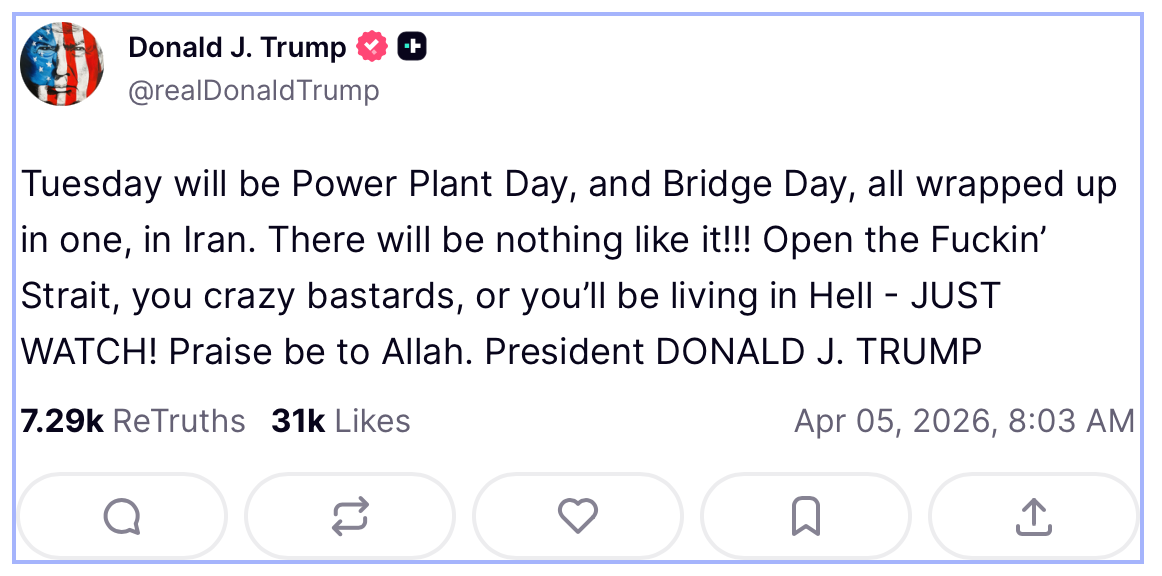
I had to sit with that juxtaposition for a moment — not as a partisan, not as a political analyst, but as a Christian who is concerned about the future of his faith. For far too long I have thought of the dissonance between these two types of sentiments as simply a political problem. More and more I am beginning to think it is and always has been a theological problem.
The God Whose Name Is Being Invoked
Earlier in the week, in a separate Truth Social post3 threatening Iran, President Trump invoked the name of God directly, “Glory be to GOD!”, using divine language to baptize military escalation as something blessed or ordained.
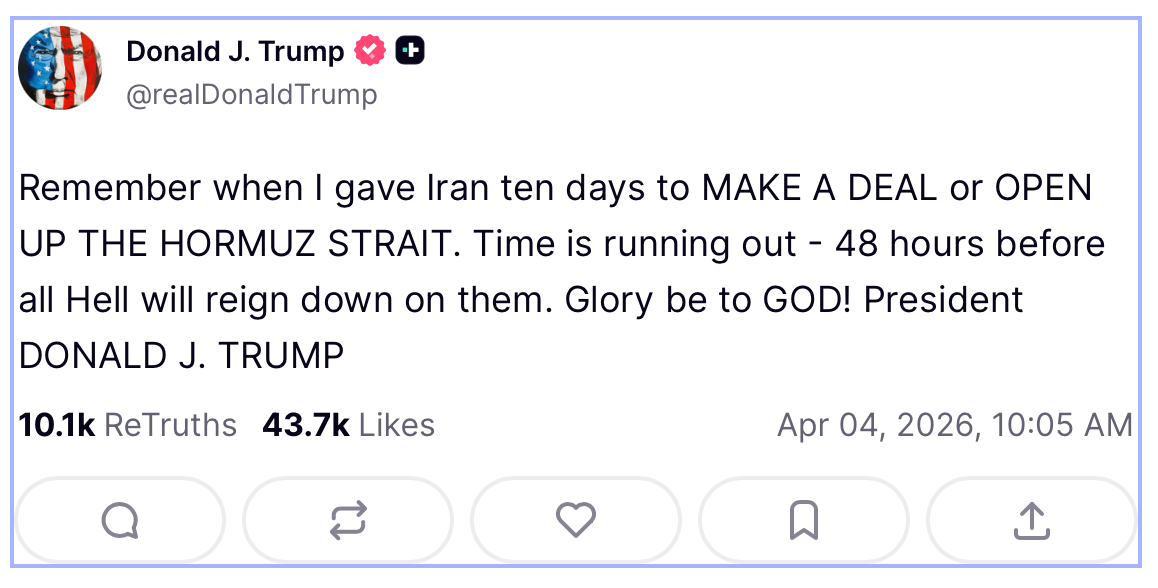
On Easter morning, he closed his threat with “Praise be to Allah”4 — not as an expression of interfaith solidarity, but as a mocking taunt directed at the Iranian people and their faith.
Here is what the Church must be willing to say out loud: You cannot weaponize God’s name against your enemies while simultaneously claiming to celebrate a risen Christ who died for those same enemies.
Scripture is not ambiguous. Romans 10:13 declares plainly: “Everyone who calls on the name of the Lord will be saved.” The word translated “everyone” in the original Greek is πᾶς (pas) — all, any, every, or the whole without exception. The prophet Joel, whom Paul is quoting5, spoke this promise into a world of warring nations, ethnic enmity, and imperial violence. The promise does not exempt the Persians. It does not exclude the Iranians. It does not carve out an asterisk for people the US president deems exempt.
When the White House spokesperson declares that Jesus is unlocking “the gates of Heaven for all of humanity,” that statement either means all or it doesn’t. If it means all, then it must include the Iranian mother who sent her daughter to school on February 28th and never saw her come home.
The Children of Minab
On February 28, 2026 — just over five weeks before this Easter morning6 — a missile struck the Shajareh Tayyebeh Primary School in Minab, a southern Iranian town. The children were in class when news of the first wave of airstrikes reached their parents. There was not enough time to get them out.
According to reporting from NPR7, the New York Times, Amnesty International, and a military investigation by the Pentagon itself, a U.S.-manufactured Tomahawk cruise missile was the likely cause. The UN Office of the High Commissioner for Human Rights described what happened as “a grave assault on children, on education, and on the future of an entire community.”8 Amnesty International initially identified at least 110 children among the dead — 66 boys and 54 girls — along with 26 teachers and four parents who had come to collect their children. In total, Iranian authorities reported 168 to 175 killed. The victims were mainly girls aged seven to twelve.9
A preliminary U.S. military investigation found the strike resulted from reliance on outdated intelligence data. The school had apparently once been adjacent to an Iranian Revolutionary Guard compound. It was still full of children on a Saturday morning.


I do not raise this to over simplify or self-righteously judge the complexity of this conflict. War is, by its nature, a series of cascading tragedies. I raise it because of what the White House spokesperson said in the same week as those children’s funeral: For me this holds too stark a contrast when the spokesperson for President Trump says “will never waver in safeguarding the right to religious liberty, upholding the dignity of life, and protecting faith in our public square.”
The dignity of life. Those words carry enormous moral weight. They are words rooted in the Imago Dei — the conviction, that we draw from Genesis 1, that every human being is made in the image of God and therefore bears inherent, irrevocable worth. That worth does not diminish when the human being is Iranian, or American, or Mexican. It does not evaporate because the child happened to be in a school that sat near a military compound. The dignity of life is either universal or it is a co-opted political slogan. It can not be both. The Church must decide which one we believe it to be.
The Irony of Holy Week at the White House
Institutional religion and the actual teachings of Jesus are not always the same thing, and Holy Week — of all weeks — is when that distinction demands our attention.
What did Jesus do in the days we call Holy Week? He wept over a city he knew was headed toward destruction (Luke 19:41). He healed the servant of the man who had come to arrest him (Luke 22:51). He prayed for the people who were killing him: “Father, forgive them, for they do not know what they are doing” (Luke 23:34). He did not draw a sword when Peter did (Matthew 26:52). He did not call down fire on his enemies. He absorbed hate, vitriol, and violence. He did not wish death upon another in order to further a political agenda.
The Risen Christ that the Church celebrates this morning is not a Christ who threatens people. He is a Christ who, on Easter morning, appeared first to grieving women and to his frightened disciples proclaiming: “Peace be with you.”10
Matthew 25
In Matthew 25, Jesus does something extraordinary. He collapses the distance between himself and the most vulnerable people in the world. “I was hungry and you gave me food. I was thirsty and you gave me drink. I was a stranger and you welcomed me... Truly I tell you, whatever you did for one of the least of these brothers and sisters of mine, you did for me.”
And then he includes what should be to most, the terrifying inverse: “Whatever you did not do for one of the least of these, you did not do for me.”
Jesus aligned himself with those most vulnerable, those who are historically overlooked and He places the tension on us to either move towards them with LOVE or to find ourselves distanced both from those he lists and himself.
The children of Minab were not our children, not our citizens, not our church members. They were Iranian and Muslim and had their entire lives ahead of them. By every measure of Matthew 25, they are exactly the ones Jesus was talking about. The girl whose father got the call that she had survived the first strike, and then — before he could reach her — received word that a second strike had killed her.11 They are certainly among “the least of these” Jesus was talking about.
How does a follower of Jesus reconcile threatening to destroy bridges, and power plants — which will cut electricity to hospitals, to homes, and to families — with loving the neighbor Jesus describes in Matthew 25?
How do we celebrate a risen Christ who; “is not slow to fulfill his promise as some count slowness, but is patient toward you, not wishing that any should perish, but that all should reach repentance”12 while planning infrastructure strikes during Passover week — a holiday that commemorates liberation from violent oppression?
These are not rhetorical questions. They are the type of questions that define whether our faith is real or performative. They are the questions that the Church in every empire in every century has had to face: will we baptize violence and power, or will we be witnesses to the love, peace, and redemption of a risen Christ?
A Call to Repentance This Easter Morning
Repentance is not a performative act. It is a spiritual one. It is available to every human being, including presidents and their advisors and the voters who sent them to office and the pastors who pass off political rhetoric as spiritual language.
Easter is not primarily a holiday about feeling good. It is about the truth that death does not have the final word — which means that the way we are treating each other right now is not the final word either. There is still time to change our course. There is still time to choose a different Way. That is what resurrection means in practice: that the patterns of violence and dehumanization we have normalized do not have to be permanent. We can repent. We can change. James 5:16 says we can be free from sin and its deforming power, “Therefore, confess your sins to one another and pray for one another, that you may be healed. The prayer of a righteous person has great power as it is working.”
To the Church specifically, I want to say this: the resurrection of Jesus Christ is either the most radical, life changing event in human history or it is simply a decorative holiday. If it is real — if the one who was executed by empire actually rose from the dead — then no government, no military, no political faction gets to define who is worthy of dignity, who qualifies as “all,” or who deserves to be called a child of God.
“Everyone who calls on the name of the Lord will be saved.”
This Easter morning, the question before the Church is simple: Do we believe that or don’t we?
If we do, then we must say so — clearly, lovingly, without political agenda, but also without flinching. We must hold our faith to a higher standard. We must refuse to let the name of Jesus be used to bless what Jesus himself would weep over.
He is risen.
“The Lord, the Lord, the compassionate and gracious God, slow to anger, abounding in love and faithfulness, maintaining love to thousands, and forgiving wickedness, rebellion and sin. Yet he does not leave the guilty unpunished; he punishes the children and their children for the sin of the parents to the third and fourth generation.” —Exodus 34:6-7

These thoughts derive directly from my life, faith, and the work I get to do every day — following Jesus, building community, and choosing compassion, courage, and hope. I serve as co-lead pastor of Hills Global Church and co-founder of Connect Global, and everything I write flows from my journey.
If something here resonates, I’d love for you to subscribe and keep the conversation going.
— Javier Mendoza
Works Cited
Rogers, Taylor, qtd. in Singman, Brooke. “White House Marks Holy Week, Easter with Days of Prayer Centered on Religious Liberty.” Fox News, 1 Apr. 2026, www.foxnews.com/politics/white-house-marks-holy-week-easter-days-prayer-centered-religious-liberty.
Trump, Donald J. Truth Social post. Fox News coverage: “Trump Vows US Will Strike Iran’s Power Plants, Bridges if Strait of Hormuz Is Not Reopened.” Fox News, 5 Apr. 2026, www.foxnews.com/politics/trump-vows-us-will-strike-irans-power-plants-bridges-strait-of-hormuz-not-reopened.
Trump, Donald J. Truth Social post referencing God and war. @realDonaldTrump, Truth Social, truthsocial.com/@realDonaldTrump/posts/116346816254869135.
Trump, Donald J. “Praise be to Allah” Truth Social post. @realDonaldTrump, Truth Social, truthsocial.com/@realDonaldTrump/posts/116351998782539414.
Joel 2:32
“And it shall come to pass that everyone who calls on the name of the LORD shall be saved”
Triebert, Christiaan, et al. “More Than 100 School Children Were Killed in Iran. Evidence Points to a U.S. Missile Strike.” The New York Times, 11 Mar. 2026, www.nytimes.com/2026/03/11/us/politics/iran-school-missile-strike.html.
Brumfiel, Geoff. “Pentagon Probe Points to U.S. Missile Hitting Iranian School.” NPR, 11 Mar. 2026, www.npr.org/2026/03/11/nx-s1-5744981/pentagon-iran-missile-school-hegseth.
“UN Experts Strongly Condemn Deadly Missile Strike on Girls’ School in Iran, Call for Independent Investigation.” OHCHR, Mar. 2026, www.ohchr.org/en/press-releases/2026/03/un-experts-strongly-condemn-deadly-missile-strike-girls-school-iran-call.
“USA/Iran: Those Responsible for Deadly and Unlawful US Strike on School That Killed over 100 Children Must Be Held Accountable.” Amnesty International, Mar. 2026, www.amnesty.org/en/latest/news/2026/03/usa-iran-those-responsible-for-deadly-and-unlawful-us-strike-on-school-that-killed-over-100-children-must-be-held-accountable/.
“UN Experts Strongly Condemn Deadly Missile Strike on Girls’ School in Iran, Call for Independent Investigation.” OHCHR, Mar. 2026, www.ohchr.org/en/press-releases/2026/03/un-experts-strongly-condemn-deadly-missile-strike-girls-school-iran-call.
“Deadly Bombing of Iran Primary School ‘a Grave Violation of Humanitarian Law’: UNESCO.” UN News, 1 Mar. 2026, news.un.org/en/story/2026/03/1167063.
“2026 Minab School Attack.” Wikipedia, en.wikipedia.org/wiki/2026_Minab_school_attack. Accessed 5 Apr. 2026.
John 20:21 NIV
Again Jesus said, “Peace be with you! As the Father has sent me, I am sending you.” And with that he breathed on them and said, “Receive the Holy Spirit. If you forgive anyone’s sins, their sins are forgiven; if you do not forgive them, they are not forgiven.”
“Exclusive: Iranian Girls Killed by ‘Double-Tap’ Strikes on Minab School.” Middle East Eye, 5 Mar. 2026, www.middleeasteye.net/news/exclusive-iranian-girls-killed-double-tap-strikes-minab-school.
2 Peter 3:9 ESV
The Lord is not slow to fulfill his promise as some count slowness, but is patient toward you, not wishing that any should perish, but that all should reach repentance.